
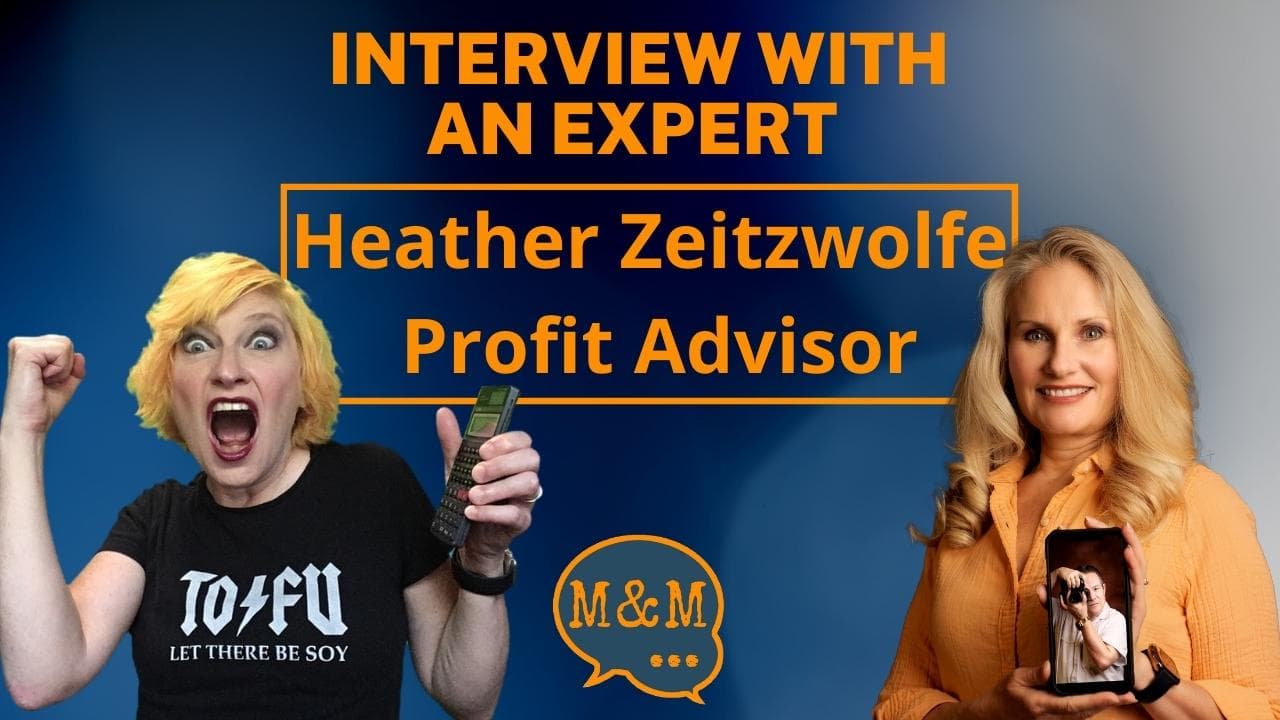
Heather Zeitzwolfe is a Profit Advisor for Digital Media Creators and Producers. She offers Profit Advising for Creative Entrepreneurs in Podcast Production – Videography – Photography – Graphic Design – Web Design.
Watch the interview on YouTube then subscribe for more great content!Heather Zeitzwolfe is a profit adviser, and she’s going to tell us how we can transition from being a content creator to a content entrepreneur. Instead of just spending money all day long, we’re going to talk about finding a balance and bringing in some money.
We’re looking forward to speaking with her and getting all of our money issues straightened out.
Heather Zeitzwolfe: I am a creative person myself, so I got into accounting late in life. I’m in my fifties, I’m about to have a birthday. I’m reaching that mid-50 point.
I originally was in theater studies. I studied fashion design, so I have that creative background.
I’ve also studied multimedia design. I have a degree in advertising. I used to work in market research. I was laid off during the recession.
I am such a number nerd, so it made sense for me to go back to school, to study accounting and I got my CPA license.
Working with creatives is totally in my wheelhouse.
But I’m one of those people that is left brain/right brain. I’ve got that creative side and I have that analytical side.
Typically with creatives, they’re following their passion when they get into business.
If they’re content creators, maybe they love doing videos and they’re not thinking about the number side of things.
Toby Younis: We deal with creatives all the time and their struggle is always getting beyond their passion.
I’m blessed with five children, two of whom are on the creative side and the other three of whom are on the technical side. It’s very easy dealing with the ones on the technical side because we have a common basis for understanding.
But when it comes to the creatives, I have a hard time giving them practical advice.
They’ve done the smart thing to get professionals like you to help them through the process.
Because they’re so enamored with their passion, they sometimes forget the more important things like insurance, accounting, banking, and legal things.
What are some of the things that you’re seeing with creators?
Heather Zeitzwolfe: The steps are to put in place a plan and have some strategy behind what they want to do with this content creation.
Is it leading towards something?
We’re supposed to have intention around what we’re doing with marketing.
It’s not like we put things out there and just hope that we get likes and follows.
It needs to lead towards some call to action where you’re making money.
So what happens?
People follow their passion, and they start doing things.
They don’t understand what it is they’re going to be making money from.
Maybe they think I’ll just do Patreon or Buy Me a Coffee, or I’ll become an affiliate. There are ideas floating out there and yes, they can generate income. But unless you have a strategy in place of how this is all going to work together, it’s going to be random things happening.
If you’re putting all of your attention into this randomness, it’s probably not going to pan out.
We’re not John Lee Dumas and we’re not going to get all kinds of money from affiliates and advertising.
Then have a plan of how you’re going to serve this client over the years.
Creatives love bright, shiny things. We get distracted from our plan.
I’m guilty of it too. I love technology. AppSumo comes out with something new and you can spend a lot of money on software.
But unless there’s a plan for it, you should be saving your money and ignoring those things.
Toby Younis: One of the best features of AppSumo is its 60-day total refund.
Creative people in various art forms, including authors, started looking at social media for expanding their reach. Many who started out as graphic artists, for instance, suddenly transitioned into content creators that happen to be graphic artists.
How much of that have you seen yourself?
Heather Zeitzwolfe: As entrepreneurs using content creation, it gives us that feeling of being busy all the time.
I’m guilty of this too. I’ve been doing a 51-day challenge on TikTok and I look at the clock and realize I just spent an hour on this 30-second video.
We have to be mindful of those types of things.
You can have a small, engaged audience with a purpose, and you can drive sales.
Get them on a discovery call or invite interaction with them. Offer them a free workshop.
You get to communicate eyeball to eyeball with your followers, and that can transcend into actual sales.
Just putting content out for people to like and follow doesn’t mean they’re going to buy anything from you.
I always have my clients create a list of where people enter into your world.
You don’t have to do this in a CRM. I do it in a spreadsheet and I find out, did they find me through a comment I made in a Facebook group? Was it a post that I did? Was it in some networking group?
Although we put a lot of effort into it, social media is not the number one driver.
Be mindful of where you are getting your leads.
Concentrate more on getting leads in your business and less on getting likes and followers.
It doesn’t take a large audience to bring in $100K a year. You can work with the folks that are in your audience and nurture them.
Toby Younis: Nurture them in the sense that they’re not just viewers. Make a distinction between viewers and prospective buyers.
Some of your viewers may become buyers, but that’s not going to happen without leading them through that sales funnel of yours.
That’s important for creative entrepreneurs to recognize that the majority of your viewers are not necessarily buyers of your products. We can rapidly become distracted by larger numbers of viewers. But that’s not the source of your income.
The source of your income is selling your art form practice, whether it’s writing books, teaching painting, or video coaching.
Heather Zeitzwolfe: I mentioned affiliates, Buy Me a Coffee, and Patreon. Creatives usually set that up because it’s so easy and the money might trickle in here and there.
You need to open up a bank account and start tracking the money that’s coming in because that money is taxable. The IRS is getting information about that.
That’s a mistake that I see people make.
It’s always easiest to have a special bank account for your business and make sure that all the things to do with your business lead into that bank account.
That way, you’re able to track it at the end of the year and not scramble around or get a nasty letter from the IRS that you forgot to claim something.
We don’t want those scary letters that can also lead to penalties, interest, and stress.
Toby Younis: Anyone who starts a YouTube channel looks forward to the day they become monetized. A thousand subscribers and 4,000 watch hours. When that happens and you apply for monetization, you’re going to get an email from Google, which owns YouTube.
They’re going to ask you for information, including your name, address, telephone number, bank account, and tax ID. If you’re not a business, you can give them your social security number.
At the end of the year, you get a 1099 from Google reporting how much you earned. They don’t take out taxes. They send that same form to the IRS. When you file your tax return that year, the IRS will compare it to what was submitted to them from YouTube or TikTok or whomever you earned revenue from.
That’s why the bank account you give Google should be independent of your personal account.
Heather Zeitzwolfe: We also have to think about if we hire people to help us.
We might have someone helping us with our social media or creating graphics or whatever. They’re a contractor, so we need to gather that information from them to get the W-9 filled out. Then at the end of the year, if we’ve paid them $600 or more, we need to issue a 1099 for them as well.
That information goes to the IRS, and it goes to that contractor.
Toby Younis: We have one credit card we use for any purchase related to the business, whether we’re purchasing something on Amazon or business cards from a print company. We use that credit card to track that information in terms of business expenses.
When you complete your tax return at the end of the year, you’ll need to know your business expenses. So it’s always easier if you have one credit card for that.
If you’re ever audited, they’re going to require that information. You’ll be able to print that out from your credit card information.
Heather Zeitzwolfe: Digital creators like technology, so use technology to your advantage. There are tons of apps where you can save receipts. You can scan a receipt and save it to that software.
Being redundant can be helpful, so scan and save business receipts to Google drive even if you have them on a credit card. Cash register receipts fade after time and if the IRS audits you, they will probably ask you for receipts.
Heather Zeitzwolfe: It depends on the type of business that you have. We could tap into things like coaching and digital courses. We mentioned affiliates and online donations and memberships, but you can also offer workshops, webinars, and downloadable PDFs.
Graphic designers can make a lot of money with downloadable PDFs on Etsy.
We can be digital creators but have a local audience, and we can serve them locally.
For instance, I’ve worked with painters who offer local painting classes.
You’re not limited to the typical digital products like coaching or ebooks, but if you go into physical products, then you have to be concerned about sales tax. So think about using some kind of third party that offers dropshipping or helps you properly manage the taxes for physical products.
Toby Younis: As a creative person, consider the opportunities for expanding with products like courses and webinars.
One of the few people that made his fortune during the ‘49 Gold Rush was asked, How did you make so much money?
He said I sold shovels to the gold miners.
You don’t have to dig for gold. You can sell shovels.
In those cases where you may not fulfill the market that wants to buy your photographs, paintings, or books; teach them how to write, paint, or take a picture.
Heather Zeitzwolfe: A digital creator can team up with another digital creator and offer some different services.
You could host a virtual summit where you’re collaborating.
I’m going to be working with another creator putting on a retreat on a cruise ship next year. We’re going to train people on a cruise about business and goal setting.
Because when you team up together, it expands your audience, and you’re not competing.
Toby Younis: We met you at the She Podcasts Live conference, which was oriented towards women learning more about podcasting or looking for partnerships. We were there to interview some folks. What were you doing at She Podcasts?
Heather Zeitzwolfe: I’m a podcaster and that was the first event I went to after the lockdown during the pandemic. That was the first time I had my mask off. I could hug people.
There were lots of people that I had met during the pandemic through Zoom, Clubhouse, Instagram, podcasting, and meetups. Having the opportunity to finally connect in a physical world with the people that I had met digitally was life-changing.
I didn’t know it was going to be so transcending, but that was the reason behind it. I figured I had clients that were there. I also thought I could meet other potential clients because I help podcasters in my business.
Toby Younis: You said that creatives have a difficult time looking at their business from an analytical perspective.
Heather Zeitzwolfe: Some people see a spreadsheet and don’t understand what they’re looking at. It’s like looking at a foreign language.
So for creatives, I take that data and create a dashboard, or a visual representation of what’s going on.
You can track all your numbers in real-time using QuickBooks. Get your banks set up and there are different apps that you can attach with QuickBooks. QuickBooks has some dashboarding tools as well.
It’s an easier way to comprehend a lot of detailed information with a snapshot.
Toby Younis: When I was a consultant, I worked with a company called Oracle. They were transitioning away from data analysis and data management to putting that information on executive dashboards. I was an adviser to that project.
I saw the potential value of a dashboard that could provide you a snapshot of where your business is based on the data beneath it.
YouTube provides a dashboard that provides you with analytics. That’s true of most of the social media applications in which people are monetized.
Dashboards are an important source of information that helps you improve your position for monetization.
What is your net income?
That’s the easiest thing to look at. For entrepreneurs, that is the amount that you can potentially put in your pocket. That’s an important number.
If you are running a very lean business with low overhead and you’re not making what you need, then you need to bring in more leads and more sales.
But if your expenses are really high, you need to think about how to reduce expenses so you can keep more money in your pocket.
Are we spending a lot of money to offer a service? Is there a lot of cost going into that? What can we offer that has less cost?
Can we increase the sales or the price overall to where we can make more money?
Look at the costs associated with each product or service that you sell and how much of that you’re selling.
If your operating expenses are too high, then your net income is going to be much lower. In some cases, it might be a net loss.
I also look at the percentage of sales. How much are you spending on each thing?
For instance, if your software costs are super high compared to your sales, maybe that is what you reduce.
I’ve worked with videographers who take on a job, and then there’s scope creep, or maybe they didn’t price it correctly.
Then what happens is they’re paying their contractors an hourly rate and when the job is done, they barely have anything left over. They’ve paid a contractor more than they’ve paid themselves.
Ask yourself,
If we are spending a certain amount of hours on a job, we must get paid accordingly.
Toby Younis: As a former professional photographer, videographer, and documentary maker, there are two things that I learned: never underprice yourself, and never discount your work.
Give them a fair and honest price, and if they don’t agree, they don’t have to hire you. Don’t take a job where you’ve discounted it so much that you put yourself at risk of losing money.
I have a friend who is a coach. He’s very proud of the fact that he earned $12,000 last year.
I asked him, how much did that cost you?
He said I spent $16,000.
At that point, it’s costing you money to be a coach.
Don’t take any job where the people that you’re working for don’t appreciate how good you are at what you do.
Heather Zeitzwolfe: When I do a scorecard, we put in place the goals that we want to achieve. Goals have to be measurable.
We also look at the types of things that we’re doing in our business, and we can score ourselves. Are we spending too much time on busy work when it would be better for us to be doing more high-level work?
If we have the means, we should be outsourcing those busy work tasks so we can give our attention to the $1000 an hour things instead of the $10 an hour activities.
Heather Zeitzwolfe: The podcast is in season three and it’s morphed over time. It’s always been for creative people in marketing, advertising, or digital media.
The second year I wanted to elevate the female voice and only interview women. That was my main focus and we dove into profitability and ways to promote ourselves.
I’ve got more bite-sized shows. The shows were longer before and now I’m making them a lot shorter.
I’ve got bonus episodes interviewing a lot of interesting creatives. I’ve started doing an advising session. If guests are interested in doing one of those, it’s a free session with me and it’ll be recorded for the podcast.
The tagline on my podcast says it is for creative rebels, freaks, misfits, and geeks that want to monetize their passion and run profitable businesses.
A lot of what happens in our business is driven by our mindset around money. If we have money blocks, that will transcend into problems with pricing, devaluing ourselves, not asking clients to pay us, or being afraid to have a sales conversation.
All of these things happen from money stories that we tell ourselves or that we’ve lived through.
That is a workshop where we dive into your passion. What are your talents and who do you want to serve, and how you can develop products and services for that particular sweet spot?
That’s how to read a profit-and-loss statement and it’s not boring. It’s very fun. I break down all the things in the profit and losses and how you can utilize that information to impact your business and make more money.
Toby Younis: I love hearing your advice, Heather, because it’s good advice for people making that transition from being a content creator to a content entrepreneur.
Heather’s services include Bookkeeping, Tax Preparation & Planning, and Profit Strategy & Planning. She offers one-on-one consulting, group programs, and an ongoing Get Radical – Profit Accelerator membership, which includes masterminds, action meetings, community, lead-gen, and accountability.
Free workshops: https://www.getthebalanceright.net/workshops
Contact Heather: https://www.instagram.com/zeitzwolfe/
Profit Tracker Tool: https://www.getthebalancerightpodcast.com/tracker
Heather & Get the Balance Right – LinkTree https://linktr.ee/getthebalanceright
M5 Meet Up: https://www.getthebalancerightpodcast.com/m5
Podcast (Get the Balance Right): https://www.getthebalanceright.net/podcast
Are you struggling to create and convert leads? Are you overwhelmed when you think about how you can stand out in the online market?
This show is for you, the encore entrepreneurs, coaches, consultants, thought leaders, and speakers – how do you gain visibility and credibility online so your ideal clients hear your message and reach out to connect with you? Expert livestreamers, Shelley Carney and Toby Younis of AGK Media Studio provide tips, tools, and strategies for creative, fun, and effective content marketing through weekly livestreaming, podcasting and blogging.
Visit with us live every Thursday to ask questions and solve problems related to creating consistent quality content to promote your brand and business.
Find our content archive here: http://livecast.life
Schedule a free consultation now at http://calendar.AGKMedia.Studio
Sign up for our weekly newsletter so you don’t miss out! http://news.agkmedia.studio/
Buy our new books, “Livecast Life” and “Women in Podcasting” here: http://books.agkmedia.studio
The Content Consistency Framework and Schedule infographics:
http://framework.agkmedia.studio
#profitadvisor #contentcreator #podcast — Send in a voice message: https://anchor.fm/messagesandmethods/message