
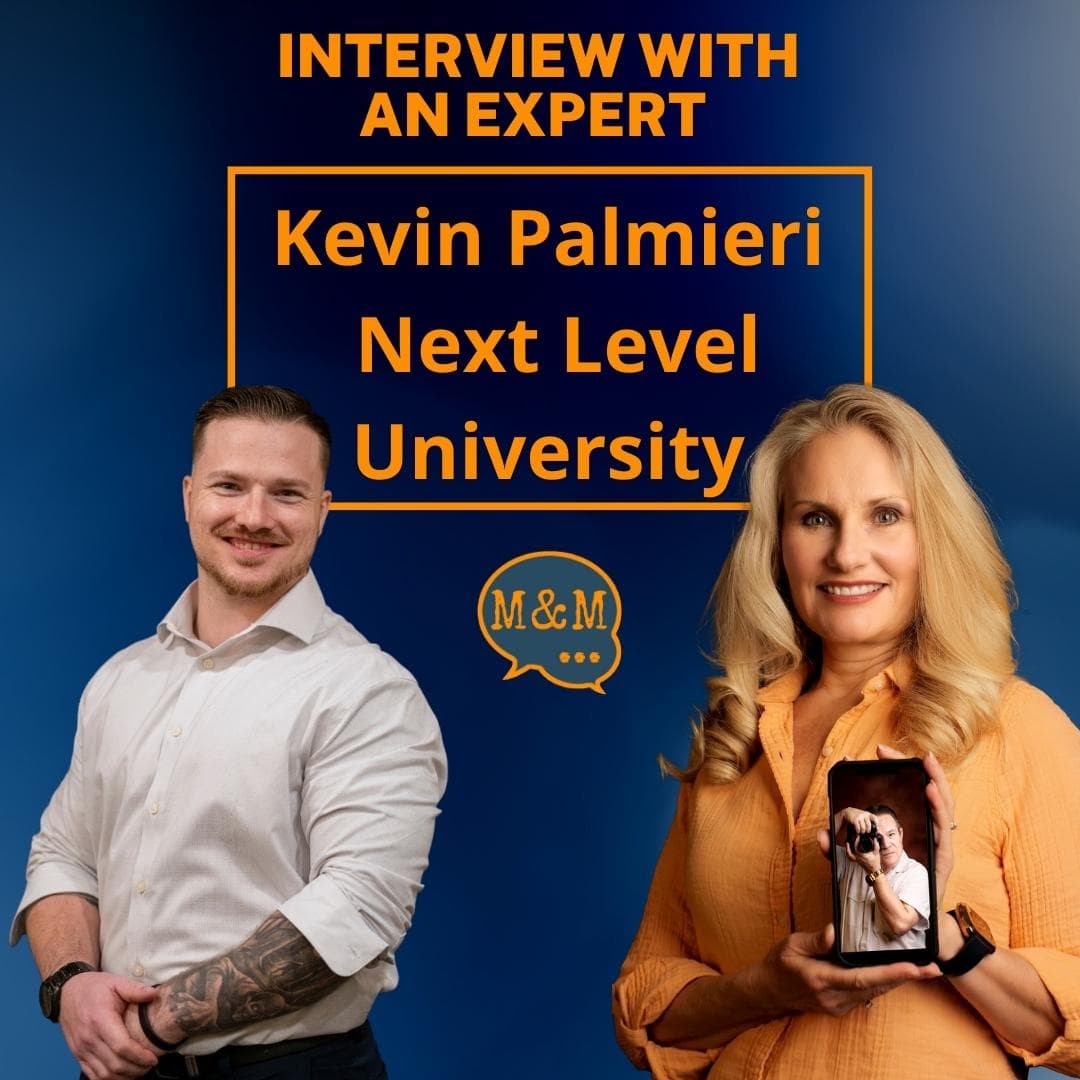
Kevin Palmieri: I never planned on being a podcaster.
When I was 25, I had everything that you could ever want. I had a sports car. I had a high-paying job. My girlfriend was a model. I was in the best shape of my life because I had done a bodybuilding show.
By all outside standards, I was living the dream, but truthfully, I was pretty insecure.
I was definitely anxious. I was definitely dealing with some depression and my girlfriend at the time ended up leaving me.
When she left me, I said to myself, I’m going to make as much money as possible because I think that’ll fix all my problems.
How many of us have fallen into that?
At my company, I did what’s called weatherization. Our job was to go into buildings, usually state-owned buildings, especially schools, and make them more energy efficient.
Since we worked for the government, I got anywhere from $60 to $120 an hour.
For a 26-year-old man with no college degree, that’s really good money.
I got a promotion to foreman, which means I start the job, I run the job, and I am on the job from the first day to the last.
Most of our work was on the road. We did a lot of traveling. If you fast forward to the end of that year, I had been on the road for 10 months out of 12.
Every single week, I was living in hotels in different towns.
But that was in alignment with me making as much money as possible and “fixing my problems.”
At the end of that, I opened my final pay stub of the year, and I had made a hundred thousand dollars at age 26 with no college degree.
But it was a very short-lived emotional roller coaster of awesome.
Then it fell down to the realization that nothing had changed.
What’s the opposite of unconscious?
Hyperconscious.
I want to live that way.
So, I started a podcast called The Hyperconscious Podcast, and that was the very beginning for me. I was interviewing friends and having deep conversations about fears, what people wanted out of life, and relationships.
In the beginning, it was a passion project.
I didn’t care about my job anymore, because I didn’t want to travel and make more money. I was burnt out.
I had this new podcast thing that was interesting.
I started calling out of work. I’d show up late, and I’d leave the job site early. I was so far past burnt out. I had been staying up for days on end and it wasn’t sustainable. But I didn’t know what else to do.
It got to where I was in a hotel room in New Jersey, which is six hours from where I lived. This was not a nice hotel. These were very sketchy, gross hotels.
It was 5:15 in the morning. My alarm clock went off. I sat up. I slid to the edge of the bed.
I was lacing up my work boots.
There were 10 televisions broadcasting in my head and every single one was on a different station.
At that moment I felt like if I was to take my life, I would take my problems with me.
I experienced this very dark pressure, hopelessness, helplessness, and fear.
I ended up sending a message to my friend, who is now my business partner, explaining the situation.
He said, Kev, so much has changed for you over the last couple of years, especially your awareness.
But your environments have stayed the same.
I think it’s time for you to change your environment.
Four months later, I ended up leaving my job and then really getting into the second half of my life, where I became a very broke entrepreneur trying to figure it all out.
We did figure it out, and we continue to figure it out.
That was the journey, and there was a lot of pain and uncertainty.
We definitely didn’t go from starting a podcast to 1100 episodes. There were a lot of lessons in between, for sure.
Shelley Carney: Half of all podcasts out there have three or fewer episodes.
People think I’ll start a podcast, that looks easy.
Then they get into it, and it’s not easy. It’s harder to come up with content than they had thought it would be. They have difficulty getting past three episodes.
You weren’t a content creator. You were a hard-working Joe, and suddenly you decided I’m going to do a podcast.
Kevin Palmieri: In the beginning, I wasn’t as consistent as I should have been, and that’s full honesty.
Then I partnered up with somebody else, and we have never missed an episode since. I think we partnered up with episode number 17 and we committed to do this together and never miss it.
We have public accountability because we have built ourselves as a brand that never misses. The pressure and public accountability that is associated with that make me show up even when I don’t want to.
This is the analogy I use.
That’s what we are with podcasting. We’re the type of people who will never miss the podcast.
We changed our identity from a couple of bros trying to do a podcast to two professional podcasters who will never miss, no matter what.
It’s not about me. It’s about the audience. We do seven episodes a week for the audience.
I didn’t wake up and say; I want to do an episode every day.
It’s a lot.
But I also realize that if we can add more value to our audience, they’ll always keep coming back. I feel a responsibility to do that at this point.
It’s a mix of a lot of things, but I identify as the type of person who will never miss a podcast episode, and I wear that proudly.
Shelley Carney: I’m hearing two things from you.
One is you adopted that identity. I am a podcaster. That is who I am.
Then you had a partner.
From what I’m hearing, you were a coach for each other. You told each other the truths about, here’s what I’m seeing, here’s what I think you need to do, here’s the direction I would suggest for you.
You were supportive of each other and you grew as humans.
I’ve done the same thing. Toby and I have been partners since 2012, and we’ve grown together. We coach each other when we’re going through difficult times. We’re always the person who the other one calls to get coaching support.
I think that’s super important for every entrepreneur, podcaster, and content creator that you have somebody in your life who coaches you, keeps you accountable, and motivates you to keep going.
I did a podcast with my friend Jen McFarland, and we talked about how there are no shortcuts to success.
There are no magic beans.
The only magic bean is to keep going and don’t give up.
Kevin Palmieri: If I tried to do the splits right now, things would most likely go horribly wrong for me. I don’t think it would be a positive experience.
But if I practice the splits every single day for the next 365 days, I’m willing to bet I’d be able to do the splits by this time next year.
If I only did it five days a week, it either may not happen or it will take a percentage longer. If I only do it three days a week, it definitely may not happen.
If I only do it once a week, I will see almost no change.
The importance of consistency is you will ignite the power of the compound effect, meaning you’re going to build momentum and get results easier in the long run than you would if you only did it when you felt like it.
You learn things along the way that you never knew you needed to know until you get to that next step.
You might do five episodes and say, that’s not for me.
But what you don’t know is you learned a lesson in the fifth episode that you’re going to use in the 10th. And in the 10th episode, you’ll learn one that you’ll use forever.
Not only will you learn more about what you’re doing, but you really can’t win without consistency.
You can’t build up momentum. You won’t learn enough about what you’re doing.
If you’re trying to build an audience, your audience will go to where the value is, and if you are not consistently there with value, they’re going to find somebody else.
My wife and I were on vacation, and we went to this restaurant. It was closed.
Number one, I did not get to experience that restaurant.
Number two, next time I go there, I’m probably not going to experience it because it wasn’t there last time.
Number three, we had to find a replacement for that restaurant.
That replacement restaurant is the one I’ll visit next time.
The one that’s consistently there for you is the one that you’re going to return to.
Shelley Carney: Consistency builds momentum, and it helps you to add on newer people that wouldn’t have heard you on day one, but they hear you on day 100.
Because you were consistent.
Kevin Palmieri: I believe this journey of success is a mix of doing what’s hard and necessary and doing what your intuition tells you to do.
I don’t always want to show up.
We recorded an episode last night at 9:30 pm after a 13-hour day. I told Alan and our audience on the podcast; I don’t want to be here right now. I’m going to be honest. But it’s important to me that I am here.
I believe that there are two types of people: people who take pride in telling you how easy it was for them, and people who take pride in how much they’ve accomplished through adversity.
Understanding what you are looking for and what you’re expecting will determine how far you make it on this journey.
I expected it to be a challenge. So, when challenges arise, I’m not surprised.
That is an important thing that I’ve learned.
The other thing that I’ve learned is many people start “the sexy.”
The barrier to entry with podcasting is really low. You can jump on Zoom and record yourself talking. You’ve got yourself a podcast.
But with the barrier to entry being lower, the failure rate is also higher.
You have to tap into why you’re doing this.
I often say people have their P’s in the wrong order. They start something from a place of profitability, and they try to convince themselves that they’re passionate about it.
If you start something from a place of passion, you’ll learn to swim long enough that you can make it profitable.
The last thing is, I think people drastically underestimate the value of one. Whether that’s an ambassador in your business, a viewer on your YouTube channel, or a listener of your podcast, it’s one customer.
One person is 100% more than you had yesterday when you’re starting out.
Perhaps you have 15 people. If that’s your audience, imagine giving a speech to 15 people. That’s a good amount of people.
Treat each person like a VIP, and I think you’ll get way further.
You’re adding value and real authentic relationships with real people.
That’s the key to long-term success.
Shelley Carney: The title of our show/blog post is Next Level Success Without Struggle. But it sounds like some things are pretty hard.
Kevin Palmieri: I believe that we have a misunderstanding of what struggling is. I think many people assume it should be easy.
Doing a difficult thing that you love, that fulfills you, will always be easier than doing something completely out of alignment.
To say without struggle means within alignment.
Growth requires resistance.
If you go to the gym and lift the same amount of weight every time, you will not grow.
If you are trying to grow, you’ll always be pushing some sort of limit.
I think that’s important for self-trust, fulfillment, self-worth, self-belief, and the relationship we have with ourselves.
Go into it understanding that there will be hard times and struggle. But if you can make friends along the way, you’ll appreciate it more.
Kevin Palmieri: When I left my job, and I started this journey, we didn’t make any money for two years.
There were two years in a row when I couldn’t buy my girlfriend Christmas presents. When we moved in together, she had to pay the rent for me for several months.
My car brakes were done, there was a hole in my engine, and I couldn’t get it fixed. I kept driving and it would stall at red lights.
It was like a sad scene from a movie. It got to where one of my credit cards was overdue and it got sent to collections.
The next challenge was understanding my limiting beliefs. I was thinking, I’m not smart enough; I don’t know enough. I could never be the type of person who’s a successful business owner.
Overcoming those limiting beliefs has been one of the hardest things in the world. Those are the things that follow you around everywhere.
People see you on stage, or they see you doing an interview, but what they don’t realize is I have to talk myself up to do that. All right, you’ve done this before, it’s going to be fine.
I had to understand my own insecurities and see where I was holding myself back.
As an entrepreneur, content creator, or business owner, there are a lot of mirrors that you might not want to look in that are required.
There was a time when my business partner and I were at an event that we were co-hosting with one of our friends. Every time we would go from talking about podcasting or speaking to business, I would shell up; almost like I wanted to leave the room.
I noticed it happening more and more.
My insecurity around lack of knowledge manifests in me shutting down, being quiet, feeling terrible about myself, and hurting my self-worth.
That was a very challenging mirror. To realize that anytime I’m uncomfortable, I go into my turtle shell and wait until I feel comfortable to come back out.
You connect the dots and say, how often have I done that in my past?
What results has that gotten me?
When you become aware of something like that, you can understand when it’s happening. Then, while you work on it, you realize what to do to stop it.
Shelley Carney: Many people we’re speaking to want to start an entrepreneurial business doing something that maybe they’ve had in the back of their mind for a long time.
They waited until they retired from their first career and now they’re looking at a new venture.
As a young man who made a hundred thousand dollars in one year and then the next two years didn’t make any money,
Kevin Palmieri: I left my job, and I went to see my mom and my grandma.
My grandmother said, why did you do this? This is terrible.
When are you going to get another job?
I told my grandmother, I will never punch another time clock in my life.
I will figure it out. I will do whatever it takes.
I can’t go back. I know that’s not for me. I know that’s not what I’m supposed to be doing.
After telling my family how I felt, there was public accountability.
I’ve quit 75% of my jobs without having a backup plan. So, for me, maybe this is happening for a reason. Maybe I need to figure out what I should actually be doing.
I was walking around my kitchen one day thinking to myself; I am single as can be, with no prospect of love.
There are very few people listening to our podcast. We had a nice small community, which I valued, but there weren’t a lot of listeners.
I have the least amount of money I’ve ever had in my entire life.
But I finally felt good about myself.
I was proud of what I was doing in the world.
That’s why I didn’t stop.
For the first time in my life, I was actually fulfilled.
I was chasing happiness before. If X happens, I will feel good.
When that moment in the kitchen happened, I realized that this part of the journey, although it’s terrible and it sucks, is also very fulfilling. I’m actually tapping into true fulfillment based on a passion, a purpose, and a mission.
I knew I would never get that if I went back to a job.
I knew at a deep level that I’d never felt this feeling before, and there was no way to replicate it by trying to accomplish somebody else’s dream.
That was when I was really hooked.
I’d gotten a little of this feeling. I will do whatever it takes to keep this.
Early on, I had to make enough money to get to the end of next month. I focused on the next 30 days because I was afraid one day I would wake up and all this would be gone.
Kevin Palmieri: I got to where I couldn’t put any more money on credit cards. That was really what clicked, I ran out of capital completely.
I had a conversation with Alan, and I said, I need to start making money. What do we do?
He said we’re a self-improvement podcast. People are listening to the show for self-improvement. We can help them at a deeper level. Why don’t we coach people for self-improvement?
I said I’m not a coach. I’ve never coached before. I don’t know what to do.
In the beginning, I messaged some of the warmest listeners we had.
Back then, people were sharing stuff on social a lot more. So, it was really easy to recognize your audience.
There was a young lady named Jenna. I messaged Jenna, and I said, Jenna, I’ve never done coaching before, but I’m going to start coaching. It’s going to be completely free to start because I want to see if it’s something I enjoy. Are you interested?
She said it’s free? Yeah, sure. Let’s do it.
I coached Jenna for two months and then I picked up some other free clients as well by messaging them and offering free coaching.
After the first couple of months, I sent the message I can’t do this for free anymore because my schedule is filling up. What do you think of $50 a call?
Everybody said yes.
I went from $0 a week to $300 a week, and that’s how this first started.
That was enough proof of concept for me.
We didn’t have that many listeners, so the fact that we could make a few hundred dollars a week convinced me to lean into serving our community to the best of our ability based on one-on-one conversations and building relationships.
Kevin Palmieri: Our audience is women or humans who identify as women. As a tattooed bodybuilder, that was never my expectation.
We understand our audience, their issues, their problems, and the buzzwords that they click on.
That’s a good thing for everybody to think about. How well do you know your audience?
Anything about relationships does really well because I think at a deep level, most people want to better their relationships. They’re afraid to say that, and they don’t know where to look.
Anytime we talk about consistency, those episodes do really well because that’s a struggle that people have.
Anytime we talk about community, not intimate relationships, but the people that you surround yourself with, those episodes do really well.
I think it’s because we will say things that are difficult to talk about. Our brand is heart driven, no BS. I will tell you exactly how I feel from my heart. I have to tell you the truth. That’s my responsibility as the guide on this podcast.
We’ll say things about are the people in your life the best from your past or the best for your future? Are your high school or college friends helping you accomplish your goals?
The episodes that help people raise their awareness first, then give them the tactics to use that new awareness, those are the episodes that do the best.
That’s the thing that we’re really focused on.
Heart-driven, but no BS is our brand in a nutshell.
Those are the episodes that do the best because it’s in alignment.
Kevin Palmieri: Many people already understand what their purpose is.
They do not understand what the vehicle to deliver that purpose is.
So, if you are looking for your purpose, look more in your past than you do anywhere else.
Your purpose has probably already touched you.
If you think about what people’s purposes are, it’s usually to help people or to help the world or improve the world.
I would ask,
When I said I had never coached before, I actually used to coach people on Snap. People would listen to the podcast, and they would reach out and I would ask, What are you going through? What can I help with?
I would coach them for free, and I didn’t really think about it. I had partners that, after we broke up, would message me for relationship advice.
I used to play baseball, and in high school, we used to do these camps for the little kids. I used to love coaching the little kids. It was awesome to be a role model for younger children.
I also used to say, imagine if you could have a job on the radio where you talked into a microphone for four hours a day. That would be the best thing ever of all time.
I always resonated with people in movies who stood up for people who were being taken advantage of.
I used to love hockey, but I always loved the enforcer. The guy who had to fight for the other members of his team. That always moved me emotionally.
So many of our audience members, women, and humans who identify as women have been taken advantage of physically, mentally, emotionally, spiritually, and sexually.
I am a man who will stand up for them. I take that abuse personally and I want to be the person who stands up for them, leads the charge, and helps them so it will never happen again.
All of that was already in my past. I had to look in the past and say, let me connect some dots.
What happens is you think to yourself, I want to help people stick up for themselves.
How the hell am I going to do that?
How am I going to make any money doing that?
Purpose is buried shallowly.
The vehicle is what people are stuck on because it doesn’t seem realistic to start a podcast and change the world, or to start a company that picks up litter off the beaches and actually turns a profit.
For me, podcasting is the vehicle.
Look in your past for your purpose. Then test out some different things to see what your vehicle might be.
Shelley Carney: There are different ways our purpose is revealed.
During the pandemic, everything was shut down. We weren’t visiting each other for Thanksgiving and Christmas. Older people, like my parents, who are in their late seventies, weren’t ready to do Zoom or video calls. They didn’t quite get it and they didn’t have the equipment or the internet ability at that point in time.
That drove me to say, I want to help people in the second half of life to set up a studio in their home, a computer with a camera, lights, and audio so that they are not cut off again.
Last March, my mom had a stroke, and she’s now confined to a wheelchair.
I went to Arizona to help my family. I told them I’m going to need a studio so I can continue to do my work.
My brother, my dad, and I set it up so that they now have high-speed internet. They have a computer with two monitors, a camera, lights, and audio. It’s all set up and I did my shows there in June.
When I left, I taught my dad how to work with the equipment. When my mom had to have video medical appointments, they knew I set them up to do it. My brother came over the first couple of times to make sure that they felt comfortable.
They had all the equipment, they had the knowledge, and they had everything they needed in place and it made their lives easier.
That experience was fulfilling because I helped my family have connectivity to the rest of the world that was missing during the pandemic.
Kevin Palmieri: There’s a difference between searching for something and recognizing it. We put a lot of pressure on ourselves to figure out our purpose.
Start looking in your past, understand yourself at a deeper level and things will reveal themselves that never did before.
Shelley Carney: Fulfillment comes to you from places that you didn’t expect or know about because they were lying dormant.
Then, as soon as something instigates that event, you see your purpose.
I need to help people in the second half of life to get connected with the world and share their wisdom with others.
It’s been a lovely journey for us.
Kevin Palmieri: When we created a free course, we didn’t think to ourselves, what’s the easiest thing that we can create and give away for free?
We said what’s the most valuable thing we can create and give away for free?
We sat down in our studio and created a course about what it takes to get to the next level.
What are the most important facets of self-improvement, growth, and success?
Consistency, community, clarity, confidence, and commitment.
Those are the things that we talk about in this course because, from our experience, that’s what sets successful people apart.
Many of us are looking for answers. We have to check in with ourselves to ask what am I doing right now? What is one small change I can make?
It is a video course for you to take at your own pace, download, and share with your friends.
Kevin Palmieri: By the end of the first module, I want you to have a deeper understanding of yourself. What you’re actually doing, why you’re doing it, and what that all means to you.
By the end of the course, hopefully, you’ll understand what you’re doing, the people you should surround yourself with, what your consistency should look like, and how committed you have to be. We take you from an identity level awareness to a tactical awareness of what you’ve got to do to get there.
Kevin Palmieri: One, understand what your unique strength is. Two, understand where your biggest room for improvement is.
I think we try to convince ourselves that we’re really good at something that we’re not, and we don’t take credit for something that we’re really good at.
When we were building this business, Alan and I had a conversation about who the CEO should be, and I said, you’ve got to be the CEO. I’m not a visionary.
I’m an operator. I’m good at getting stuff done behind the scenes.
If you are an entrepreneur, make a list of five things that you know are your unique strengths. Then make a list of five things that are important improvement points for you to focus on. Delegate the weaknesses.
I think that’s why so many podcasts fail because people think to themselves, I’m not consistent, but I’ll figure it out. No. Get a partner and you’ll be more consistent. If you understand yourself, you can plan accordingly.
As an early entrepreneur, make sure you understand yourself and then build everything based on that understanding.
Shelley Carney: Capitalize on your strengths and get a partner to fill in for your weaknesses.
Kevin Palmieri: There’s no shame in that. It’s being smart and using the strengths of the people around you to make it a win-win.
Shelley Carney: As humans, we thrive in a community. We raise a family as a village, and our children turn out better. Always look for help from your community where you need it.
Reach out to Kevin for that free course or to listen to his podcast, Next Level University on all major podcast platforms, including YouTube.
Kevin Palmieri: The biggest difference between who you are and what you have right now and who you want to be in the future is your habits.
Do a little every day to move the needle. Over a long enough period that can really add up. It won’t happen overnight, but it can happen.
Shelley Carney: If you haven’t yet, hit the subscribe button on YouTube, follow the podcast or blog, and check in with us weekly. We have great content in all formats.
Kevin Palmieri is the CFO, Founder & Co-Host of Next Level University, a Global Top 100 Self-Improvement podcast with more than 1000 episodes reaching over half a million people in more than 125 countries.
When’s The Last Time You Really Felt ON PURPOSE?
When you felt CLEAR about what you wanted…
When you felt 100% COMMITTED to your goals?
When you truly felt CONFIDENT
When you felt the most CONSISTENT & Aligned
When’s the last time you had a supportive COMMUNITY lifting you to the next level?
In this course, we show you STEP BY STEP what you can do to get to the next level.
https://next-level-university-courses.teachable.com/p/what-it-takes-to-get-to-the-next-level
Connect with Kevin
www.linkedin.com/in/kevin-palmieri
www.instagram.com/neverquitkid
Are you struggling to create and convert leads? Are you overwhelmed when you think about how you can stand out in the online market?
This show is for you, the encore entrepreneurs, coaches, consultants, thought leaders, and speakers – how do you gain visibility and credibility online so your ideal clients hear your message and reach out to connect with you? Expert livestreamers, Shelley Carney and Toby Younis of AGK Media Studio provide tips, tools, and strategies for creative, fun, and effective content marketing through weekly livestreaming, podcasting, and blogging.
Visit with us live every Thursday to ask questions and solve problems related to creating consistent quality content to promote your brand and business.
Find our content archive here: http://livecast.life
Schedule a free consultation now at http://calendar.AGKMedia.Studio
Sign up for our weekly newsletter so you don’t miss out! http://news.agkmedia.studio/
Buy our new books, “Livecast Life” and “Women in Podcasting” here: http://books.agkmedia.studio
The Content Consistency Framework and Schedule infographics:
http://framework.agkmedia.studio
#confidence #contentcreator #podcast — Send in a voice message: https://anchor.fm/messagesandmethods/message