
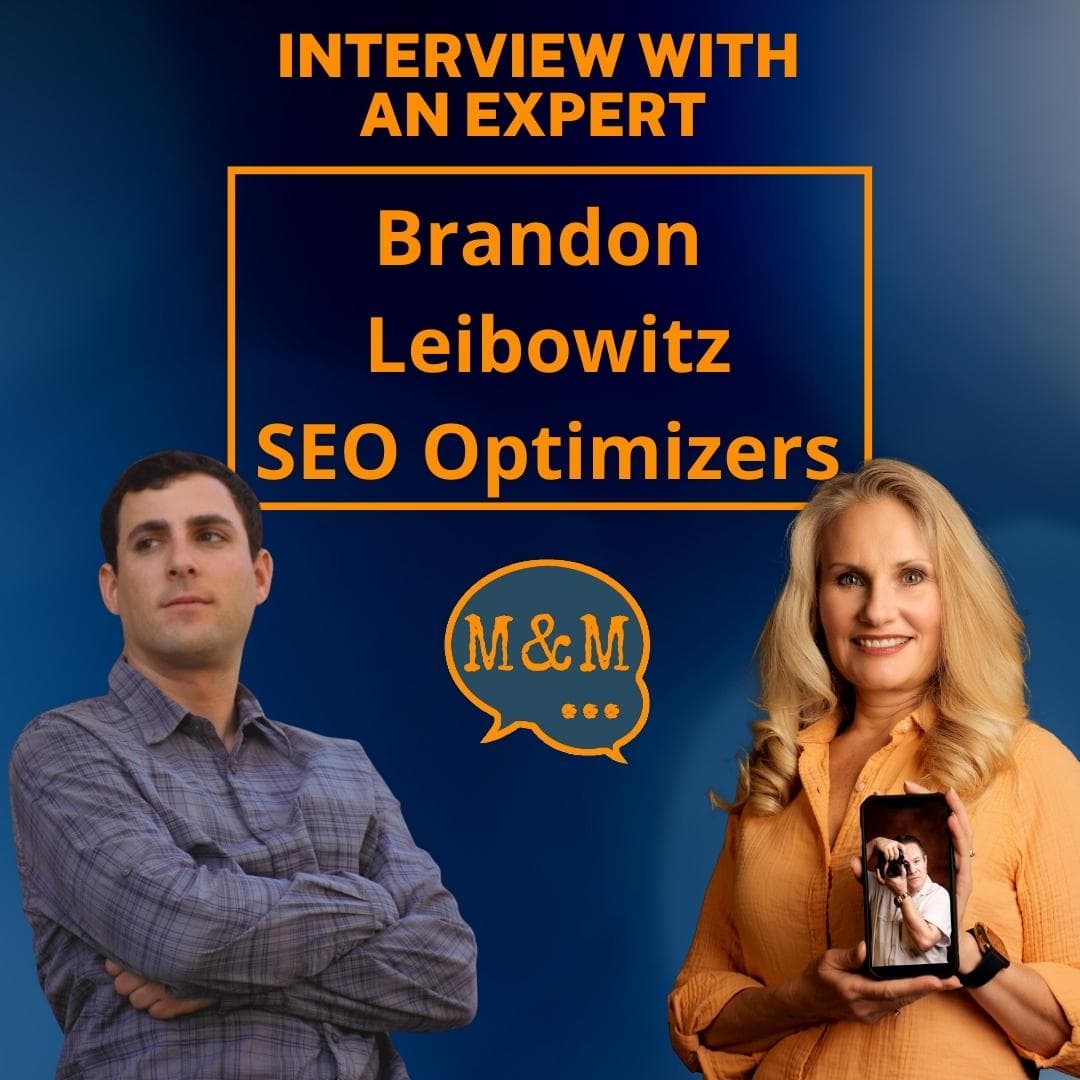
Brandon operates SEO Optimizers, a digital marketing company that focuses on helping small and medium-sized businesses get more online traffic, to convert into clients, sales, and leads.
Watch the interview on YouTube then subscribe for more great content!SEO does take time, so a lot of people get discouraged because they’re not seeing traffic coming in. If you want immediate results, that’s where social media or paid ads come into play.
Run some paid ads and you’re going to get traffic right away. While waiting for the SEO to kick in, a lot of people will have paid ads going. Then once the SEO starts working, they can scale back on the paid ads and push more money into the SEO.
Brandon Leibowitz: After I graduated from college back in 2007, I got my first job doing digital marketing, helping a company with their SEO and social media, paid ads, email marketing, taking pictures of products, and doing it all for them.
I realized that everyone’s probably going to have a website in the future and everything I was doing works to get traffic.
But SEO is a way to get free traffic.
So I thought, why spend money on paid ads when you can get ranked up there for free?
I’ve been focused on that ever since, working at different advertising agencies.
Then, before or after work, I would build my company until I could quit my job and focus solely on helping people get free traffic.
Brandon Leibowitz: Knowing where to be.
There are so many channels to market yourself and people get lost in the weeds.There are so many channels to market yourself and people get lost in the weeds.
Do I need to be on Facebook, Instagram, Twitter, YouTube, Pinterest, LinkedIn, Google, or Yelp?
They really need to focus on who their audience is and where their audience is active.
Ask yourself, if I was looking for my product or service, where would I go?
Where would you go to consume that content?
The number one thing I think with digital is trying to be in front of your audience at the right moment.
Brandon Leibowitz: SEO stands for search engine optimization, which means optimizing a website for search engines.
It really means ranking on Google.
When you search on Google, there are ads at the top. Those are all paid ads. They pay Google every time someone clicks on their ad.
It could be a couple of cents per click. It could be a couple of dollars per click. It could be a couple of hundred dollars per click.
Right below those ads are the organic listings. There are 10 spots on that first page of Google.
SEO is about getting you ranked on the first page in the organic results, so you’re not paying every time someone clicks.
In the past, there were just 10 websites that appeared on the first page of Google in the organic listings. But now there are images, videos, and maps. So the goal is to take up as much free real estate as possible on that first page of Google.
Optimize all your images on your website for your local business, getting you on Google Maps or Google My Business.
Try to get a presence on YouTube sooner than later because Google owns it and they’re going to promote it as much as they can. If you have any videos, optimize those.
Anytime you search for videos, mostly you’re going to see YouTube videos.
SEO is trying to capture free traffic.
Brandon Leibowitz: With SEO, it’s not a one-size-fits-all.
Figure out what’s going on with your website versus the competitors’ websites. See what they’re doing compared to what you’re doing and discover the disconnect.
The goal is to identify who’s on that first page of Google for your keyword.
How much SEO have they done and how could we do a better job of it?
What keywords are on their website?
If it’s a video, look at the title, description, and captions, and reverse engineer to understand what they did to get to that level.
With videos, watch time is a key metric.
How long do people watch your videos?
If it’s a 30-minute video and people watch it for one minute, that’s not a good sign. If people watch it for 29 minutes, that gives YouTube a positive signal.
Shelley Carney: I’ve always heard that if you want to hide a dead body, then the second page of Google was the best place because nobody ever looks there.
When I was setting up our show for this week, I visited your website, and ever since, whenever I go to a blog post or an article or anything where they’ve got Google ads, you pop up.
I see you everywhere now. I’m amazed at how much you have infiltrated my feed by just me visiting your website once.
Brandon Leibowitz: Those are called remarketing ads.
Anytime you go on Amazon or you look at a product and you don’t buy it, those ads usually follow you around.
Anyone that goes to my website and doesn’t do a specific conversion, I follow them around with different types of ads.
If you’ve reached out and we’ve done a free website analysis, then I’ll give you ads promoting testimonials.
Anyone that goes to my website and doesn’t do a specific conversion, I follow them around with different types of remarketing ads.If you haven’t booked a website analysis, then I’ll give you ads to book a call with me.
Target your audience and segment them into different groups.
The majority of traffic is going to leave your website immediately.
Try to keep yourself top of mind and capture the traffic that came to your website using remarketing ads. That works really well for most businesses.
Shelley Carney: You’re one of the few people that I’ve ever interviewed that’s happened with.
I can tell that you do what you tell other people to do. That is always an indicator to me that you know what you’re doing and you follow through.
Toby Younis: It sounds to me like you’re not recommending SEO exclusively without putting money into it. There’s some money involved in the remarketing ads.
Brandon Leibowitz: That depends on your business.
I’m marketing to my traffic, so it depends on how much traffic you’re getting to your website. That’s your audience.
Let’s say you’re getting a thousand people to your website every single day. That’s a thousand people that you could follow around with remarketing ads.
But if you’re only getting five people to your website a day, that’s a lot less money that you’re going to be spending.
You can spend $10 to $20 a day and hit a pretty big audience.
For cold outreach ads, it depends on your return on investment.
If you’re selling hats or T-shirts, you can’t spend that much money because each hat only costs maybe $25.
But if you’re selling cars or insurance or luxury items, you’re probably going to make a few thousand dollars. So you could spend a lot more trying to acquire that customer.
Make sure that you get a positive return on ad spend.
If you’re getting a positive return on ad spend, then keep pushing more money into that. Start off small, scale it up, and grow it along the way.
The more money you put into it, the more you’re able to test.
Initially, if you are able to spend more money, you could throw ads up everywhere and then narrow them down.
For instance, if males 20 to 25 are clicking, but they’re not converting, cut them out. If males 30 to 35 are converting, push more money into that.
Eventually, you find a smaller, more targeted demographic of those who convert.
But you never know what’s going to work until you try it.
Toby Younis: If your client had some money to invest in online advertising, how do you recommend they funnel that correctly?
Brandon Leibowitz: If they’re just doing ads, I would say test it all out. Throw everything against the wall, see what sticks. Push more money into that.
Pull money away from what’s not working.
Try mainly Google ads.
It’s probably going to be the best starting point because when people search on Google, they’re looking actively. They have that intent.
With social media, you’re interrupting people based on interest, demographics, and targeting. But that doesn’t mean they’re interested in your product or service right now.
Maybe in the past, they were, or in the future, they will be, but that doesn’t mean they want it now.
Whereas on Google, they’re looking.
There’s a lot you could do with Google.
Test with Google search ads, which are just like text ads. You could do banner ads. Google owns YouTube, so you could do YouTube video ads. You could do Gmail ads.
Some ads are going to be a lot cheaper than others. Search ads that are just text ads are very expensive, whereas video ads are pretty cheap.
With video ads on YouTube, you get 30 seconds free.
If someone watches your YouTube video ad for 29 seconds and then skips it, you don’t pay a penny. After 30 seconds, you only pay 10 cents a view, which is much cheaper, and you got people to listen and hear your message for 30 seconds. That conveys much more than a simple search text ad, in which you only get a few hundred characters.
Toby Younis: If you’re on YouTube, should you also be doing YouTube advertising?
Brandon Leibowitz: No, they don’t help each other out. Doing paid ads will not help you rank higher on Google or YouTube or anything like that. They’re all completely separate.
Brandon Leibowitz: I could get you followers, grow your accounts on social media, or I could get you traffic by ranking you higher on Google.
But if we do not optimize your website for conversions, you will not get those leads.
Half the people who come to your website leave immediately. So keep yourself top of mind with multiple touchpoints using remarketing ads.
Try to capture people’s email addresses so you can send them email updates and newsletters and offer value.
Optimize your content above the fold on your website.Give them value. Don’t promote yourself. Give tips and advice and tricks that work.
You’ve got to have a website that’s optimized to convert people.
Optimize what is above the fold. Understand that most people never scroll down on a website to see the content below the fold.
If you don’t have all your important information at the top of your website, you’re losing over 70% of people because they never scroll down.
Have your call to action above the fold, whether that’s an email form or a buy now button. Put your phone number up there or whatever you want people to do.
You’ve got to make sure it’s easy to see, it’s clean, and it looks good on mobile.
The majority of the traffic will come from mobile.
Share your value proposition and let people know what’s in it for them.
Use a couple of bullet points or a video, because people’s attention spans are pretty short.
Hook and capture them right away. Then keep them interested so they want to learn more about your product or service.
Brandon Leibowitz: That depends on who your audience is and where they are.
People can get bogged down trying to be on every platform.
You should have a presence and have your username claimed on every platform.
But being active on every platform takes a lot of time. You just need to be active where your audience is at.
An SEO company, a lawyer, or a doctor will probably not get many people coming to them on Facebook or Instagram. Some people might find me that way, but the majority of people are going to search on Google or Yelp.
Just because TikTok and Instagram are the most popular ones doesn’t mean that’s where your audience is at.After they find me there, they check my reviews or social media for proof that I’m a legitimate, credible, and real business.
That’s a way to build trust, which also helps with conversion.
Many people will go to your website, but they will not trust you. So getting them to trust you with social proof, newsletters from email marketing, and ads if you want to target them that way, helps build that trust.
Brandon Leibowitz: I think they could definitely succeed.
Social media and SEO are separate.
Social media is a way to drive more traffic to your website.
You want to send people to your website because you own that website.
Social media is your rented space on these platforms and the engagement is so low that it doesn’t get any reach.
Having a website is number one.They could take you down at any time.
Send everyone to a website that’s yours.
You need to have a website because that’s yours forever. You own and get full control of that.
Everything else is not yours.
You’re just renting space, helping these other platforms get richer by using your content and then serving ads on top of them. They’re making money from your work.
YouTube will give you some money, but they don’t really pay out that much. For every thousand views, you might make a dollar.
Brandon Leibowitz: No. SEO will help you get more exposure if someone’s searching on Google or YouTube. I can help your videos rank higher organically on YouTube so you get more views and more visibility.
It’s not just optimizing for Google, it’s pretty much anywhere.
If you’re searching on Amazon, there are ways to make your products rank higher on Amazon.
It can make your business rank higher on Yelp.
Anywhere there’s a search feature, there is an algorithm and a way to optimize your listing on that platform to rank higher and show up organically.
Brandon Leibowitz: No, they’re different. But there are similarities and ways to test.
Just like with ranking on Google through SEO, there are ways to test ranking higher on Yelp or any of these platforms.
They’ll give you some best practices and standards that they’re looking for.
If you follow what they’re looking for and then do some testing on your own to see what works and what doesn’t work, then you’ll find that secret sauce that helps to get more exposure.
Brandon Leibowitz: Growing your email list is not easy.
Entice people with something on your website for free.
You could give out a free ebook.
If you’re an e-commerce website, you can give people a coupon code for first-time purchases to get 10% or 15% off.
Don’t make it a long, complicated form, especially on mobile. Just ask for their email address.
Even having a name field is going to reduce the number of people that fill it out.
The more fields you have, the fewer conversions you’re going to get.
Any way you can, capture that email address.Just adding the word name in there is going to drop conversions.
Once you get their email, then you can follow up and say, thanks for signing up for my email list. Here is your free whatever. Also, can you tell me your name?
You can start asking all those questions like their phone number or whatever contact information you want in the follow-up emails.
With the remarketing ads we were talking about, you can upload a list of email addresses and target them with the remarketing ads on Google or any of these platforms.
Brandon Leibowitz: Everything is shifting to video.
People want visual content and attention spans are really short.
Start creating videos online, especially on YouTube and platforms like that.
People want to see your face.
It’s tough for people to get in front of the camera, but once you do it the first time, it’s pretty easy.
Once you do, it’s easy to keep pushing that content out.
Everything is shifted towards mobile and it will not slow down anytime soon.
Mobile screens are a lot smaller, so you must make sure your website is optimized for mobile.
Maybe you trim it down and don’t have all the same features that you have on the desktop version on the mobile version.
While websites are mobile-friendly, often they’re not optimized for conversions on mobile.
You don’t want to have it cluttered, so make sure your website is clean and looks good on a small screen.
Brandon Leibowitz: With digital marketing, it all takes time and patience.
SEO does take time. It’s not immediate. It takes about six months on average.
It could be more or less, depending on the competition and all these other variables. But SEO takes time.
Many people get discouraged. They’re not seeing those desired results. They’re not seeing traffic coming in, but you’ve got to keep working at it and stick with it because it takes time.
If you want immediate results, that’s where paid ads come into play. Run some paid ads, and you’re going to get traffic right away.
If you want to supplement while you’re waiting for the SEO to kick in, get paid ads going. Then once the SEO starts working, you can scale back on the paid ads and push more money into SEO.
Google doesn’t trust anyone for the first six months, so you’ve got to give Google time to trust you. It’s not something you can do overnight.
Brandon Leibowitz: I teach a lot of classes about SEO and digital marketing, but I have a free class that anyone could attend. It offers in-depth information about SEO, how it works step by step, and shows you strategies.
I put a bunch of my classes on YouTube for free about all aspects of digital marketing including paid Google Ads, Google Analytics, Facebook, Instagram, YouTube, Twitter, marketing, how to rank higher on Yelp, how to rank higher on Google Maps, and how to do keyword research.
I show you all the stuff that needs to be done to rank higher on Google or get more exposure online.
We just barely scratched the surface today, so if you want to learn more, Check out that class on my website at seooptimizers.com/gift.
Shelley Carney: Definitely take advantage of Brandon’s content because this man knows what he’s talking about. He’s everywhere in my feed now. Wouldn’t you like the same for your business?
If somebody clicked on something they saw on Google and went to your website and then suddenly you are everywhere and constantly top of mind for them, what could that do for your business?
Claim Your SEO Gift From Brandon Leibowitz & the SEO Optimizers Team. Special Early Access to our SEO Masterclass. Learn How We Use Search Engine Optimization To Increase Our Sales & Leads. https://seooptimizers.com/gift
Connect with Brandon:
Homepages
https://www.youtube.com/c/BrandonLeibowitz/videos
https://www.linkedin.com/in/brandonleibowitz/
https://www.instagram.com/leibowitzbrandon/
https://www.facebook.com/BrandonLeibs
Tweets by BrandonLeibsAre you struggling to create and convert leads? Are you overwhelmed when you think about how you can stand out in the online market?
This show is for you, the encore entrepreneurs, coaches, consultants, thought leaders, and speakers – how do you gain visibility and credibility online so your ideal clients hear your message and reach out to connect with you? Expert livestreamers, Shelley Carney and Toby Younis of AGK Media Studio provide tips, tools, and strategies for creative, fun, and effective content marketing through weekly livestreaming, podcasting and blogging.
Visit with us live every Thursday to ask questions and solve problems related to creating consistent quality content to promote your brand and business.
Find our content archive here: http://livecast.life
Schedule a free consultation now at http://calendar.AGKMedia.Studio
Sign up for our weekly newsletter so you don’t miss out! http://news.agkmedia.studio/
Buy our new books, “Livecast Life” and “Women in Podcasting” here: http://books.agkmedia.studio
The Content Consistency Framework and Schedule infographics: http://framework.agkmedia.studio
#SEO #socialmediamarketing #podcast — Send in a voice message: https://anchor.fm/messagesandmethods/message