
There’s a phase in every creative project that feels almost worse than the blank page.
It’s not broken.
It’s not finished.
It’s almost right.
The engine runs, but it doesn’t hum yet.
In Episode 107, we began there, in the messy middle. That liminal space where your instinct is to paddle harder, force the landing, grip tighter. But as we talked through it, something deeper surfaced. The real discipline isn’t working harder. It’s holding the space open long enough for something coherent to emerge.
That messy middle isn’t just a creative problem.
It’s a relational one.
And it’s a civic one.
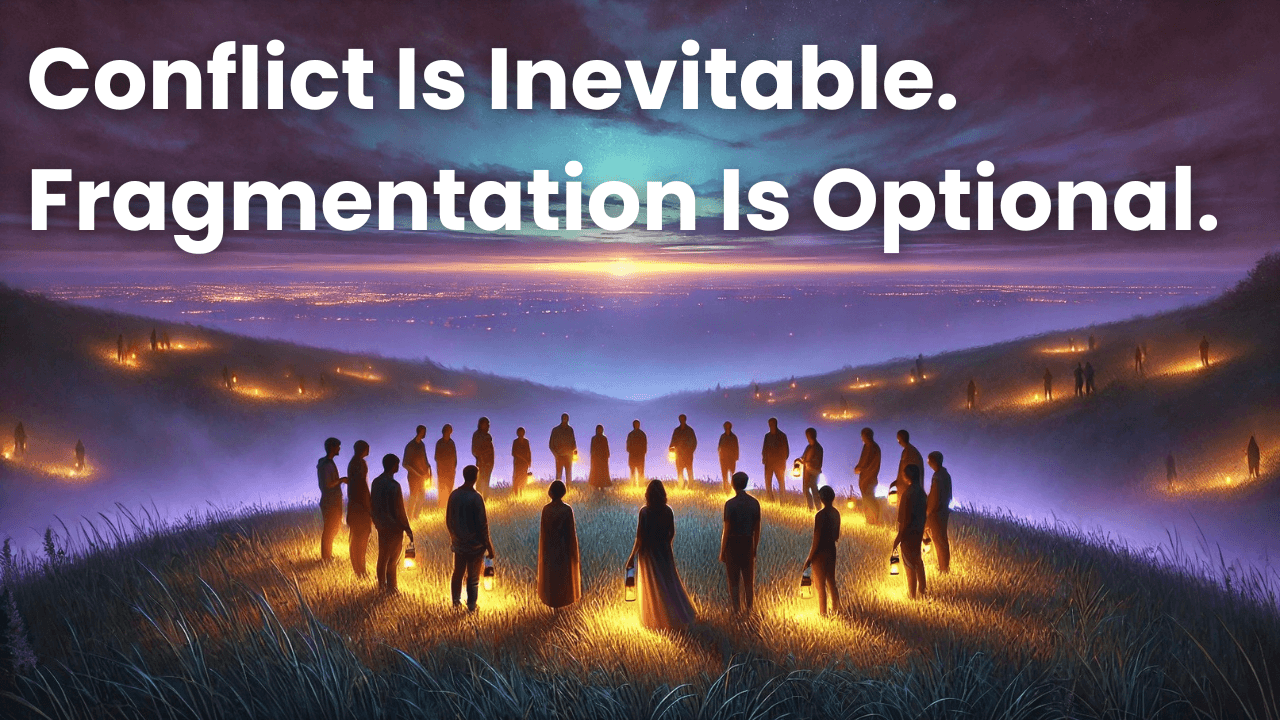
Season Two has been building an architecture. We started inward with presence, agency, and ethical power. Stabilize yourself. Regain your steering. Hold your lantern.
But eventually, you hit the wall.
The wall is other people.
Unless you are living alone in a cave, your lantern is not the only light in the room.
So Episodes 107 and 108 pivot us from individual integrity to shared stewardship and then into the even harder terrain: how to remain connected when alignment fractures.
In 1954, summer felt dangerous.
Locked and drained public pools. Empty playgrounds and parks. Hospital wards hummed with the mechanical rhythm of iron lungs keeping paralyzed children alive. Polio was an invisible predator that mostly targeted the young.
We often tell that story as the story of Jonas Salk, the lone genius in a white coat. But that’s not how eradication actually happened.
Yes, Salk developed the formula. But the cure wasn’t the vial. The cure was the network.
1.8 million children took part in the field trials.
Hundreds of thousands of nurses, doctors, principals, and volunteers.
No computers. No email. Just clipboards and trust.
Parents signed consent forms allowing their children to be injected with a version of the thing they feared most in the service of something larger.
When Edward R. Murrow asked Salk who owned the patent, he replied, “The people… Could you patent the sun?”
It sounds poetic. It was actually systemic thinking.
If he had patented it, distribution would have slowed. Trust would have fractured. The breakthrough would have stalled.
The lesson is not that one man was powerful.
It’s that power scaled because it was shared.
Coherence is stronger than agreement.
But let’s not romanticize shared work.
In Episode 107, Alicia told the story of a community project that almost imploded.
A student in her hometown died of a heroin overdose. The school went silent. The air changed. Grief demanded action.
So a coalition formed to create a music video PSA with teachers, artists, and students. A beautiful mission.
It unraveled in fifteen minutes.
Arguments over lighting styles. Over logos. Over creative control. Ego colliding with ego. The how started eating the why.
It nearly failed.
Until someone quietly said the girl’s name.
And the room shifted.
Not because everyone suddenly agreed.
But because they remembered the mission.
Agreement is intellectual. It requires sameness.
Coherence is energetic. It requires direction.
The friction remained. The vector unified.
That is stewardship.
There’s hard science under this.
We are open-loop emotional systems, a fact confirmed by research from Hatfield, Cacioppo, and others, which shows that we don’t just observe emotion; we catch it. Your fear becomes my fear in milliseconds. It kept us alive on the savanna. It wreaks havoc in Slack channels.
Then add group polarization. Cass Sunstein’s work shows that when moderately concerned people discuss an issue together, they leave more extreme than when they entered. The group amplifies emotions. Technology accelerates amplification.
Biology plus amplification equals volatility.
But here’s the stabilizing truth:
Dysregulation spreads, but so does steadiness.
A regulated nervous system is not passive. It is influential.
When one person lowers their tone, slows their breath, and refuses to match the rising velocity in the room, they change the field.
This is why we offered the Lantern Walk practice in Episode 107.
Before you speak, run your words through three gates:
Does this increase clarity?
Does this strengthen trust?
Does this move us forward together?
When the temperature rises, you lower yours. When the speed increases, you slow it down.
You create drag against chaos.
You don’t have to be the sun. You just have to hold your lantern steady.
But episode 108 pushes us further.
Shared stewardship is one thing when people mostly agree.
What happens when they don’t?
To answer that, we went backward again to 1787, to Philadelphia, to a room with the windows nailed shut in oppressive summer heat.
The Constitutional Convention was not calm marble statues making rational decisions. It was sweaty, exhausted men at their wits’ end. Large states feared irrelevance. Small states feared annihilation. Slavery overshadowed every debate.
They did not solve it by agreeing.
They built a structure of containment.
Two houses. Compromise formulas. Mechanisms that allowed deeply opposing views to coexist long enough to form something durable.
Agreement did not hold that room together.
Containment did.
That distinction matters in our homes as much as in history.
Then we moved into something even more intimate.
Years of quiet political tension inside a family. The polite holidays. The careful avoidance. The internal narratives, like “How can you believe that?”
And then a stroke.
A glass of water dropped. Slurred speech. Helicopter blades cutting the sky.
In the hospital room, antiseptic in the air and machines humming, the arguments vanished.
Not because anyone changed their mind.
But because mortality clarified priorities.
The disagreements didn’t disappear. They softened.
“It became very hard to convince yourself that a policy disagreement was extinction-level when you were standing together, wondering if your grandmother would survive the night.”
Real fragility reveals what is actually existential.
We misdiagnose threat constantly.
Surface conflict is about logistics, budgets, schedules, and policies.
Identity conflict is about who we are.
Existential threat is the story: “If you win, I disappear.”
Fragmentation happens when we mistake layer one for layer three.
And projection accelerates the slide.
Projection is the mind’s exhaust pipe. Instead of sitting with our insecurity or fear, we export it. “You are dangerous.” “You are corrupt.” The other person becomes a symbol of our destabilization.
The amygdala fires. Cortisol floods. Empathy shuts down.
And then we attack our own.
We used the immune system metaphor in Episode 108 for a reason.
A healthy immune system distinguishes between threat and self.
An autoimmune system loses that distinction and attacks its own body.
Fragmentation is social autoimmunity.
We attack our own communities, our own families, our own institutions, in a desperate attempt to feel safe.
So, what is the practice?
Contain, don’t collapse.
Regulate first.
Separate the issue from identity.
Clarify the underlying value.
Choose connection over short-term victory.
Containment is not compliance. It is not surrender. It is muscular empathy.
It is the discipline of saying:
“I can hold my values without breaking the bond.”
That is capacity.
And capacity is influence.
Choose one collective space.
Choose one strained relationship.
For seven days, do not fix it.
Do not convert.
Do not escalate.
Lower your tone when others escalate.
Slow your speech when others speed up.
Run your words through clarity, trust, and forward motion.
Notice where you escalate when you could stabilize.
Be the thermostat, not the thermometer.
And observe what happens.
Because steadiness scales.
Many lanterns.
One direction.
Walk steadily.
We’ll meet you in the field.