
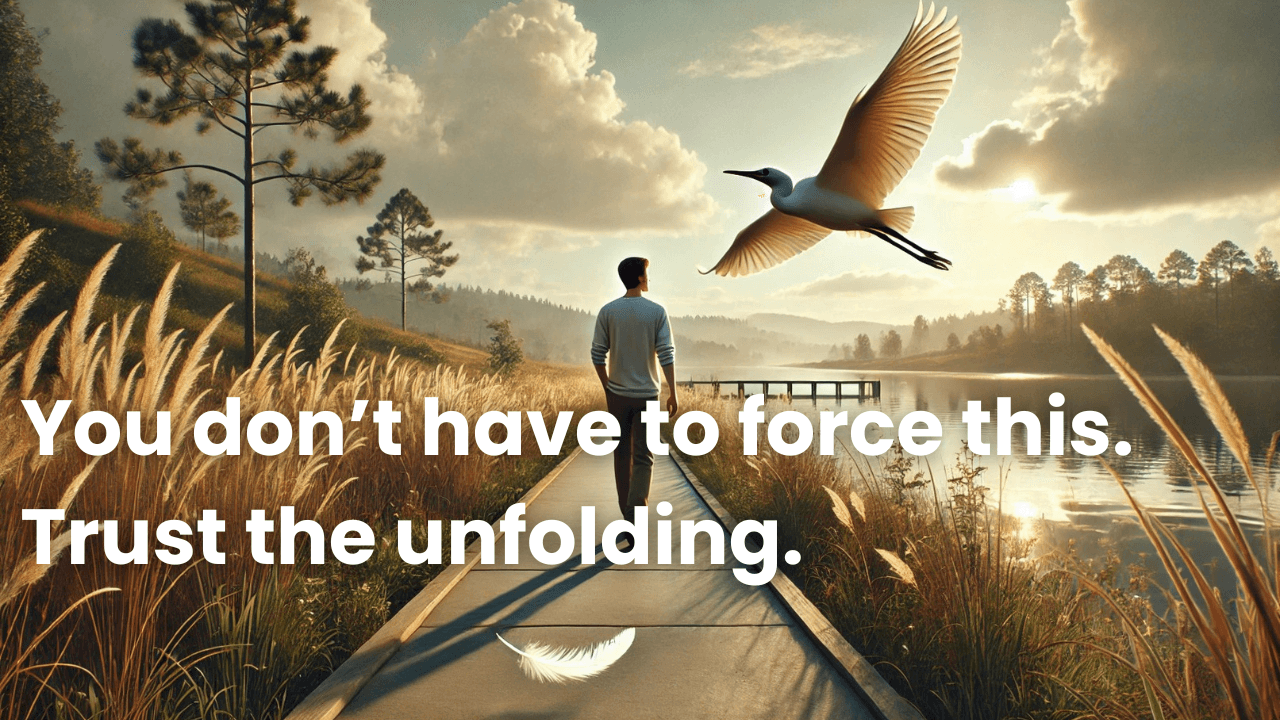
There’s a moment many of us reach in the manifestation process where the usual advice stops working.
You’ve clarified what you want.
You’ve visualized.
You’ve taken action.
And yet—something still feels tight.
That’s often the moment we assume we need to push harder.
But Episodes 89 (Divine Timing) and 90 (The Art of Non-Forcing) of Vibrations and Manifestations invite a different question:
What if the problem isn’t a lack of effort, but a lack of allowing?
This Field Guide explores how Divine Timing and non-forcing are not passive concepts, but intelligent, embodied ways of cooperating with life.
In Episode 89, we reframed Divine Timing as something far more compassionate—and far more practical—than waiting.
Divine Timing isn’t about things happening later.
It’s about things happening when your internal system is ready to receive them without resistance.
When timing feels off, it’s often because:
As shared in the episode:
“Divine timing isn’t the universe withholding, it’s life coordinating.”
Waiting, in this sense, isn’t punishment.
It’s preparation.
Episode 90 picks up right where Divine Timing leaves off.
Because once you stop pushing when things should happen, the next challenge is learning how to move while you wait.
One of the most resonant stories from the episode comes from dating after divorce—entering new connection with awareness, only to realize later that effort had quietly turned into force.
There was real chemistry.
Real connection.
And underneath it all was tension.
Checking messages.
Managing pacing.
Trying to secure emotional safety before it had time to form.
The realization came later:
“I wasn’t repeating old situations. I was repeating the old energy.”
Forcing often masquerades as being responsible, communicative, or proactive. But the body knows the difference long before the mind catches up.
This isn’t just spiritual language, it’s biology.
Psychologist Daniel Kahneman showed that the brain has a limited capacity for decision-making. When we’re forcing: overthinking texts, managing outcomes, rehearsing possibilities, we drain that capacity quickly.
The result is:
According to Stephen Porges’ Polyvagal Theory, when the nervous system perceives uncertainty as a threat, it shifts into vigilance. Blood flow moves away from the prefrontal cortex, the part of the brain responsible for insight, creativity, and connection.
In simple terms:
When you’re forcing, your best thinking goes offline.
This is why ease isn’t indulgent, it’s functional.
And it mirrors an ancient spiritual principle.
In Taoist philosophy, Wu Wei means “effortless action.” Not passivity, but action taken in cooperation with the current rather than against it.
As distilled in Episode 90:
“Flow is not the absence of effort. It is effort without friction.”
A sailor still works.
They just work with the wind.
These tools are designed to be used in real time—not saved for later.
Ask yourself:
Pressure feels tight, urgent, mentally loud.
Flow feels steady, spacious, quietly clear.
Ease is information.
Before acting, ask:
If action is meant to regulate anxiety, it’s probably forcing.
Before sending a message:
If the answer is no, pause.
“Connection doesn’t need to be chased to be real.”
Instead of planning five steps ahead, ask:
Then watch what unfolds with less friction.
Imagine your life as a landscape:
Sometimes flow doesn’t mean quitting; it means rerouting.
Here’s the through line between these two episodes:
Divine Timing governs when.
Non-Forcing governs how.
Together, they teach us that alignment isn’t passive, it’s responsive.
You still show up.
You still act.
You just stop abandoning yourself in the process.
This week, choose one small moment to practice allowing.
One email.
One conversation.
One decision.
Pause.
Check your body.
Choose the path of least internal resistance.
Not because it’s easier, but because it’s wiser.
As shared in the episode:
“Aligned action may ask for courage, but it will not ask you to betray your own ease.”
Let that be your compass.